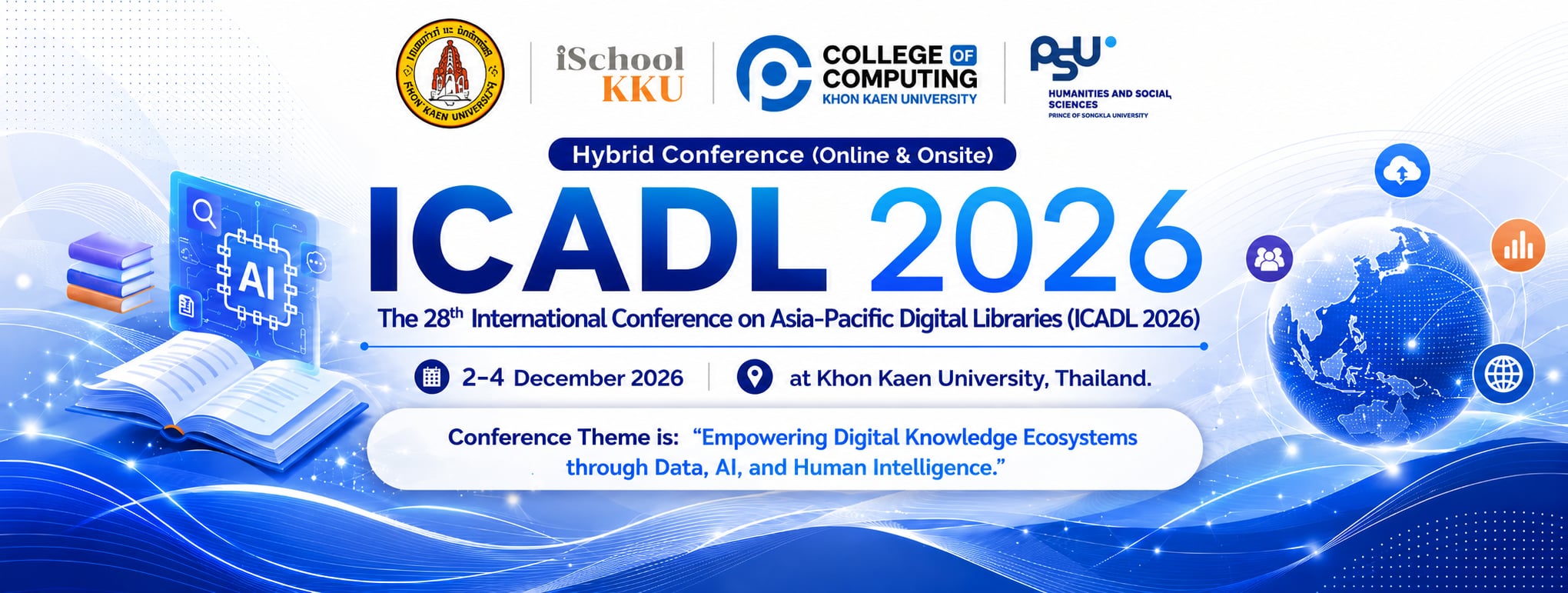
ICADL 2026 Banner
ABOUT
ICADL 2026
The 26th International Conference on Asia-Pacific Digital Libraries (ICADL 2026)
2-4 December 2026 at Khon Kaen University, Thailand.
Conference Theme is: “Empowering Digital Knowledge Ecosystems through Data, AI, and Human Intelligence.”
sub-themes:– DIK and Digital Libraries
– AI, Data Science, and Analytics
– Sustainable Computing
– Social Analytics

The International Conference on Asia-Pacific Digital Libraries (ICADL), which started in Hong Kong in 1998 and over the years traveled many countries in the Asia-Pacific region, is a major digital library conference. Along with JCDL and TPDL, ICADL is held annually as one of the three top venues for connecting digital library, computer science, and library and information science communities. This year, ICADL 2026 will be held from December 2nd to 4th, 2026 at the Khon Kaen University in Khon kaen, Thailand as an onsite face-to-face conference; however, for those who cannot attend, ICADL 2026 will allow them to present their papers online and join sessions.

The theme for ICADL 2026 is “Empowering Digital Knowledge Ecosystems through Data, AI, and Human Intelligence“. As generative artificial intelligence (AI) is gaining widespread use, it has the potential to positively and negatively impact digital libraries and their stakeholders. This conference welcomes papers that explores the role of generative AI in digital libraries and other information intensive environments.

Proceedings of ICADL 2026 are going to be published by Springer as an LNCS volume, which is indexed by Scopus. This year, we have the following four submission categories: full papers, short papers, practice papers, and demo/poster papers.

CALL FOR PAPERS

Call for paper and submission link are available at the conference’s …

Proceedings of ICADL 2026 are going to be published by Springer as an LNCS volume, which is indexed by Scopus. This year, we have the following four submission categories: full papers, short papers, practice papers, and demo/poster papers.

If there is any interest for organizing workshops, tutorial, and panel sessions with ICADL 2026, we will consider them on request. Please contact conference organizers (To: Assoc. Prof. Dr. Kanyarat Kwiecien (kandad@kku.ac.th) Khon Kaen University) with your proposal. The information about the accepted events will put on the conference website and we will encourage attendees to join the events.

The review for practice paper submissions will put less emphasis on the novelty and more on real world practices and applications of DL technologies in institutions or companies.

TOPICS

Topics of interest

  • Information retrieval and access technologies to digital collections
  • Data mining and information extraction
  • AI for digital libraries
  • Natural language processing techniques in digital collections
  • Knowledge discovery from digital libraries content
  • Recommender systems for digital libraries content
  • Data science, AI, and LLM techniques for digital libraries
  • Semantic Web, linked data, and metadata technologies
  • Ontologies and knowledge organization systems
  • Pretrained language models and digital libraries
  • Generating prompts for large language models
  • Conversational Information Retrieval
  • Detecting content created by generative AI
  • IoT and digital libraries
  • Visualization, user interface, and user experience

  • Cultural heritage access and analysis
  • Dealing with history, literature, and music in digital libraries
  • Cultural heritage and museum informatics
  • Collaborations among archives, libraries, and museums
  • Digital cultural memory initiatives
  • Memory organizations in the digital space
  • Participatory cultural heritage
  • Community Informatics
  • Intellectual freedom, censorship, misinformation
  • Intellectual property issues
  • Policy, legal, and ethical concerns for digital libraries
  • Information policies
  • Misinformation and disinformation
  • Impact of generative AI on digital library policy and practice
  • Societal and cultural issues in knowledge, information, and data
  • User engagement with digital cultural heritage in local communities New
  • User needs in multicultural and multilingual information environments

  • Information seeking and search behavior in digital environments
  • Information behavior analysis
  • User experience (UX) design and evaluation of digital library systems
  • User needs, expectations, and satisfaction in digital libraries
  • User studies on AI-powered search and recommender systems
  • Trust, transparency, and explainability of AI from users' perspectives
  • AI literacy and information literacy in the age of generative AI
  • User behavior with generative AI tools for scholarly research
  • Cross-lingual information seeking behavior in Asia-Pacific contexts
  • Information seeking and misinformation/disinformation detection by users
  • Accessibility and inclusive design for diverse user groups
  • Student and researcher information behavior in digital scholarship
  • Health information seeking behavior and use of AI health tools
  • Mobile-first UX in accessing digital collections

  • Infrastructures & development of Web Archives
  • Applications and quality assurance of digital libraries
  • Research data and open access
  • Novel interfaces for digital library access
  • Curation and preservation technologies in digital libraries
  • Information organization support
  • Novel applications for digital libraries
  • Social networking and collaborative interfaces in digital libraries
  • Personal information management and personal digital libraries
  • Information service technologies in digital libraries
  • Digital library/digital archive infrastructures
  • Digital preservation and digital curation
  • Research data infrastructures, management and use
  • Open data initiatives and utilization

  • Access and usage of Web Archives
  • Social, legal, ethical, and financial issues of Web Archives
  • Collection development and discovery
  • Higher education uses of digital collections
  • Digital library education and digital literacy
  • Digital scholarship and services
  • Crowdsourcing and user-generated content
  • Information work and digital libraries
  • Participatory cultures and digital libraries
  • Education with digital libraries
  • Generative AI and the digital library user experience
  • Researcher behavior in finding, using, and sharing research data New
  • User perception and adoption of Open Access resources New
  • Citation behavior and information use patterns in the AI era

  • Green AI and energy-efficient computing
  • Green data centers and cloud computing
  • Internet of Things (IoT) and sustainable systems
  • Hardware and system design for sustainability
  • Software engineering for sustainability
  • Sustainable computing metrics and assessment
  • Smart cities and sustainable digital transformation
  • Circular economy and IT sustainability
  • AI for sustainability (AI for Good)
  • Policy, ethics, and governance in sustainable computing
  • Green AI adoption in developing countries
  • Sustainable computing framework for AI literacy in education

SUBMISSION

All submissions must be in English, in PDF format. Papers should follow Springer Computer Science Proceedings guidelines .

01.

Formatting & Submission Lengths

The lengths of submissions should be as follows:

  • Full papers: 12-14 pages + references
  • Short papers: 6-8 pages + references
  • Practice papers: 6-8 pages + references
  • Demo/poster papers: 4-6 pages + references
02.

Review Process & Presentation Policy

The review process is double-blind. At least 3 Program Committee members will review each submission. The review for practice paper submissions will put less emphasis on the novelty and more on real world practices and applications of DL technologies in institutions or companies. Sufficient time will be given to the oral presentation for accepted papers in all submission categories either in-person or using an online presentation platform to be chosen later (e.g., WebEx). Each accepted paper must be presented by at least one of the co-authors.

IMPORTANT DATES

The schedule is shown below. All the dates are Anywhere on GMT+7 time zone:

Full, Short Research and Practice Papers Submission
July 24, 2026
AP iConference
27-31 July 2026
Acceptance Notification
September 8, 2026
Camera Ready Copy of Papers
October 1, 2026
Conference
2-4 Dec. 2026

CONFERENCE COMMITTEE

Conference Chair

  • Assoc Prof Kanyarat Kwiecien, Khon Kaen University (KKU), Thailand.

ICADL Program Committee Co-Chairs

  • Professor Fabio Crestani (Università della Svizzera Italiana (USI), Switzerland)
  • Assoc Prof. Shuntaro Yada (University of Tsukuba, Japan)
  • Assistant Prof. Yi Bu (Peking University, China)

AP iConference Co-Chairs

  • Professor Jie Ma (Jilin University, China)
  • Assistant Prof. Naya Sucha-xaya (Chulalongkorn University, Thailand)

Publicity Co-Chairs

  • Prof. Chei Sian Lee (Nanyang Technological University, Singapore)
  • Prof. Lihong Zhao (Wuhan University, China)

Workshop Co-Chair

  • Assoc Prof. Songphan Choemprayong (Chulalongkorn University, Thailand)
  • Assoc Prof Kanyarat Kwiecien, Khon Kaen University (KKU), Thailand
Faculty of Humanities and Social Sciences, Khon Kaen University logo
Faculty of Humanities and Social Sciences, Prince of Songkla University logo
College of Computing, Khon Kaen University logo
Faculty of Science, Khon Kaen University logo

ACCOMMODATION & CONFERENCE VENUES

Conference Venue

The conference will be held at Khon Kaen University, Thailand, during 2-4 December 2026.

Accommodation

Participants are encouraged to arrange their accommodation early. The following hotels are conveniently located near Khon Kaen University and offer a range of options to suit different budgets and preferences.

Official Conference Hotel

Located within Khon Kaen University campus, Bayasita Hotel offers the most convenient access to the conference venue. The hotel provides comfortable rooms, free Wi-Fi, and on-site dining facilities.

Distance to Conference Venue: 400 m. Walking distance (within KKU campus)

Transportation

Khon Kaen University is approximately 15–20 minutes from Khon Kaen Airport (KKC) by taxi or ride-hailing services such as Grab. Most recommended hotels are located within a short driving distance of the conference venue.

Nearby Hotel

  • GO Hotel Khon Kaen Campus : A budget-friendly hotel located close to Khon Kaen University, suitable for participants seeking convenient and affordable accommodation.
  • The Charm Boutique Resort : A comfortable boutique-style resort located near Khon Kaen University. The property offers a peaceful atmosphere, spacious rooms, and easy access to restaurants and local amenities. It is approximately 1.5 km from Khon Kaen University.
  • XOTEL : A modern hotel offering contemporary facilities, comfortable rooms, and convenient access to Khon Kaen University and the city center.
  • Ad Lib Hotel Khon Kaen : A modern lifestyle hotel in the city center with excellent dining options and easy transportation to the university.
  • Avani Khon Kaen Hotel & Convention Centre : A premium hotel offering spacious rooms, meeting facilities, and a wide range of guest services.